WELCOME TO FASHION AS A 2ND LANGUAGE: ARE YOU FLUENT?

FA2L is for anyone who cares about beautiful things–clothing, shoes, accessories, home furnishings–and the interconnected tribes of those who make, sell, market and desire them. If something speaks to you, buy it now or hold your peace: there are links in each story, so the item you want is just a click away. I'd like to hear from you, too: please view my profile, use the email button and send me your comments.MG

Thursday, January 28, 2010

Gird Your Loins: Fashion Straps on the Armor


2009 was a turbulent, sometimes terrifying year, whose aftershocks are still reverberating around the world. Now, in the aftermath of the economic meltdown, global conditions resemble a medieval landscape created when companies tossed thousands of hapless workers over fortress walls, raised the drawbridges and left roving bands of fugitives to fight it out amongst themselves.

Fashion folk reacted to this cultural shift in wildly different ways. Some brands panicked. Others hunkered down. More than a few went out of business. At the same time, plenty of savvy young designers took a different tack: they listened to the chatter of international distress signals and turned out clothes and accessories offering protection (or, at the very least, escape) from the harsh new world. Many of these kids share a sort of guild mentality that fuses Project Runway fantasies with cooperative group dynamics ("all for one and one for all
" or, perhaps more accurately, "you scratch my back, I'll scratch yours"). And the undisputed Queen Bee of this busy fashion hive is Lady Gaga.

FA2L loves Gaga, but this post isn't really about her, beyond the fact that seeing her recent show at Radio City reminded us about armor, or–as it's called now–metal couture. Over the years, we've toured some of the world's great armor collections and stood in awe before leather-and-bronze breastplates from ancient Greece; head-to-toe steel casements topped with ostrich plumes from 16th-century Spain; and spectacular Samurai get-ups from feudal Japan. We've even met an eccentric Englishman who so firmly believes he's a reincarnated 15th-century cavalry officer, he's collected–or made by hand–all the gear he wore in his past life (and continues to use in this one)!

Of course, when it comes to armor, we're not alone in our fascination: Diana Vreeland was obsessed with the stuff (and famously charmed the Metropolitan Museum of Art's resident expert into allowing a valuable Spanish breastplate, filled to overflowing with frothy, handmade lace, to stand in for Velásquez at the center of her legendary Balenciaga exhibit). And, to bring things up to date, it was exciting to see 21st-century armor in Lady Gaga's video for Bad Romance (center photo, above) and onstage during her current tour.

The chin guard in Bad Romance, and the arm guard and headpiece in the third photo, above, are the work of Spanish designer Manuel Albarran. His intricate designs have been featured in recent editorials and advertising campaigns, often thanks to the keen eye of Nicola Formichetti (who also works with Lady Gaga). FA2L is eager to see some of these items in person, and we'd also like to (gently) suggest
Albarran find a way to increase production. If the fashion industry continues to face an uphill battle, its creative legions will need to suit up. And we're not talking about grey flannel or navy pinstripes.

Wednesday, January 20, 2010

It's Iconic: Gucci Collector, Presented by Christie's

Fashion, by definition, is fleeting, but style endures–especially if the item in question is built to last. And while FA2L is most interested in the passions motivating creators and collectors, we do pay close attention to anything that influences shoppers and thus determines whether or not money changes hands. Fashion copy is full of code words (euphemisms, really), weighted to tip a consumer's mental scales in favor of buying. So cheap separates become better basics, ugly bridesmaids' dresses are labeled Special Occasion and overpriced-but-underwhelming designer goods are reborn as Investment Dressing.

This silly jargon would be funny if contemporary shoppers weren't so gullible. But as post-Industrial tastes shifted from quality to quantity, whole skill sets were lost, along with any context for choosing beautiful, handmade items over shiny gewgaws with shockingly brief shelf lives. As a result, true investment dressing, meaning a reliable wardrobe of distinctive, well-made clothes and accessories (which, by the way, we heartily endorse) was lost in the mass stampede.

Still, there's always hope. We particularly like Gucci's new arrangement with Christie's auction house, whereby collectors are encouraged to submit photographs of vintage pieces to online costume specialists who will do their best to provide accurate appraisals. Gucci plans to open a museum in Florence in 2011 (its 90th anniversary), so the experts at Christie's are looking for special items the company might want for its permanent collection. Meanwhile, there's a brand-wide focus on house icons, including updated versions of the bamboo-handled handbag and the Jackie shoulder bag (which, for Gucci aficionados, are true investment pieces). In tough economic times, it's that much more important to follow shopping's cardinal rule: you get what you pay for.

Photograph of vintage Gucci handbag courtesy of Gucci Collector: Presented by Christie's.

Tuesday, January 19, 2010

Trussardi 1911: Will Americans Dare to Wear It?

For a small Italian firm that began by making gloves, Trussardi 1911 has come a long way; and under the current creative leadership of Milan Vukmirovic the label is evolving even more rapidly as it nears its 100th anniversary. Trouble is, the company's clothes and accessories are so unapologetically decorative they haven't made inroads with American shoppers. It's still a label for fashion insiders, whose quest for rare items provides a thrill that's often lost when brands go global.

But Trussardi is in no immediate danger of ubiquity on this side of the Atlantic, because average Americans don't like to stand out: they find comfort in Beau Brummel's mossy platitude that to attract notice is to be over-dressed. Nonsense. In the 21st century, the phrase "over-dressed" is just Victorian hot air. FA2L knows Kander & Ebb were much closer to the mark when they (or, perhaps more accurately, Liza) suggested that life is a cabaret. In other words, get your act together or prepare to be booed off the stage.

Saturday, January 16, 2010

Guardians of Temple Louboutin Have Red Soles

Before gaining notoriety as author of the first Simpsons episode, cartoonist Mimi Pond produced a slim volume called Shoes Never Lie (Berkley, 1985), the funniest monograph-cum-humor book ever written about footwear and lust. If you're a regular FA2L reader, you've seen it quoted here before. On the subject of red shoes, Pond waxed poetic:

Red shoes are possibly the darkest of all secrets that women keep from men. Though men are frustratingly immune to the lure of most footwear, red shoes are a different matter altogether. They allow you to hold the opposite sex in your sway. At the sight of them, men become befuddled and confused. They stammer and perspire and must pull at their neckties like some poor cartoon character. The funniest part of all is that they think it's your perfume, or your personality.

Christian Louboutin's own fame post-dates Pond's book, but the man knows from red shoes: his signature soles are lacquered a glossy, candied-apple crimson. He's also stretched heels to astonishing new heights, and, in the process, gained thousands of followers who attend each new collection like Delphic pronouncements. It's easy to imagine anthropologists of 2075 writing about Louboutin as the leader of a veritable cult, just as Roger Vivier, Charles Jourdan and Manolo Blahnik were before him. Meanwhile, some clever fashion student will probably find a way to combine vertiginous stilettos, shiny red soles and enough rocket fuel to launch late-21st-century stylistas into orbit.

Monday, January 11, 2010

Lacoste 101: Revisiting a Tried-and-True Classic

Limited editions have great appeal: spending one's hard-earned money on something only a fast-acting (or lucky) few will possess is much more satisfying than buying mere stuff. Lacoste first produced these aviator-style 101 sunglasses in 1980, and is now celebrating the frame's 30th anniversary by re-issuing 1000 pairs (complete with original temple grips and anti-reflective mineral lenses). They won't last long. Knowing this, FA2L has kept words to a minimum and suggests you get a pair while the getting is good. Ready, set, shop!

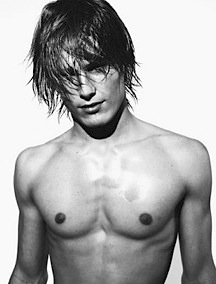
Photograph: Karl Simone. Grooming: Yinna Wang. Model: Grayson
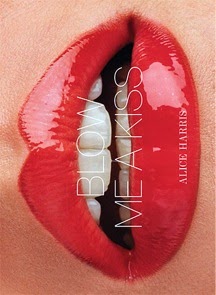
@ dna models. © Fashion As a 2nd Language & Karl Simone. See more of Simone's work in Scott Barnes' book, About Face. Look in the sidebar at right: scroll down to find the cover.

Tuesday, January 5, 2010

Devon Scott, A Tailor For Modern Gentlemen


Traditional menswear manufacturers, left to their own devices, are often rule-bound, stodgy and dull (cardinal sins in the world of fashion). However, even elementary items–suits, shirts, ties–can turn glorious in the hands of the right designer. Make no mistake: tinkering with the basics is tricky business, requiring an appreciation of tailored subtleties leavened with just enough originality to make the old new; and while "updating the classics" may sound like a walk in the park, it's more like running a marathon. Long apprenticeships, followed by years spent building credibility, will exhaust even deep reserves of stamina.

And yet, sometimes–like Athena springing fully formed from Zeus's head–a not-so-traditional menswear collection seems to appear out of nowhere. Such is the case with Devon Scott. This dashing young man from High Point, North Carolina has no formal design training (he moved to Manhattan to pursue acting), but growing up with a stylish grandfather left him obsessed with the finer points of classic tailoring. This served him well as a sales associate at Jeffrey New York (a job he took to pay the bills while pounding the pavement), where he gradually realized he wanted to design clothes rather than merely sell them. His first collection of dress shirts sold out, giving him confidence to take on tailored clothing. He found a small Long Island factory presided over by a third-generation tailor; and although the learning curve was steep, Scott was a quick study. He's also a quintessential gentleman, so even though some of his requests (for details like high armholes, slim lapels and very narrow silhouettes) were met with disbelief, he persevered and eventually won over the factory's resident experts.

Scott's clothes aren't flashy, but they're sharp, smart and beautifully detailed–a burgundy blazer, cut from buttery cashmere, has a softly-draped shawl collar and real mother-of-pearl buttons, and a grey flannel suit, though double-breasted, is so Art Deco-sleek it has no extra bulk. The pièce de résistance is his vested dinner suit, with roped shoulders and a trim waist. It's simply perfect, the sort of wardrobe staple a man appreciates every time he puts it on. As for the designer himself, he's too modest to praise his work: "The clothes," he insists, "should speak for themselves." They do, Devon, in dulcet tones, and FA2L loves what they say. At Jeffrey New York, 212.206.1271.

Photo 1
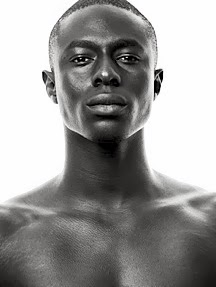
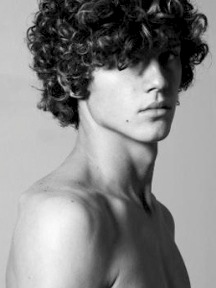
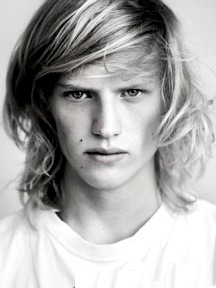
: Wool suit by Devon Scott. Cotton shirt by Gucci. Silk-and-cotton tie by Alexander Olch. Photo 2: Cashmere blazer by Devon Scott. Cotton shirt from the Black Fleece Collection by Brooks Bros. Jeans by Edwin. Alligator shoes by Gucci. Photo 3: Wool 3-piece tuxedo by Devon Scott. Cotton shirt by Costume National Homme. Shoes by Bottega Veneta. Photo 4: Cotton shirt by Devon Scott. Sterling silver cuff links by Robin Rotenier.

Photographs by Michael Stratton. Grooming by Lorenzo Martone at Link NYLA. Michael Whittaker and Michael Elmquist at dna models. Styled by Mark Grischke. © Fashion As a 2nd Language & Michael Stratton.

Monday, January 4, 2010

New York, London, Paris...Moscow? Russian Chic

Is Russian Vogue destined to be the next French Vogue? It seems to be heading in that direction, with sharp editorials like this, photographed by Alasdair McLellan (featuring FA2L New Fashion Face, Hannah Holman; you'll find her in the sidebar, right). Perhaps the land of Czarist splendor is ready for another close-up. Stay tuned.